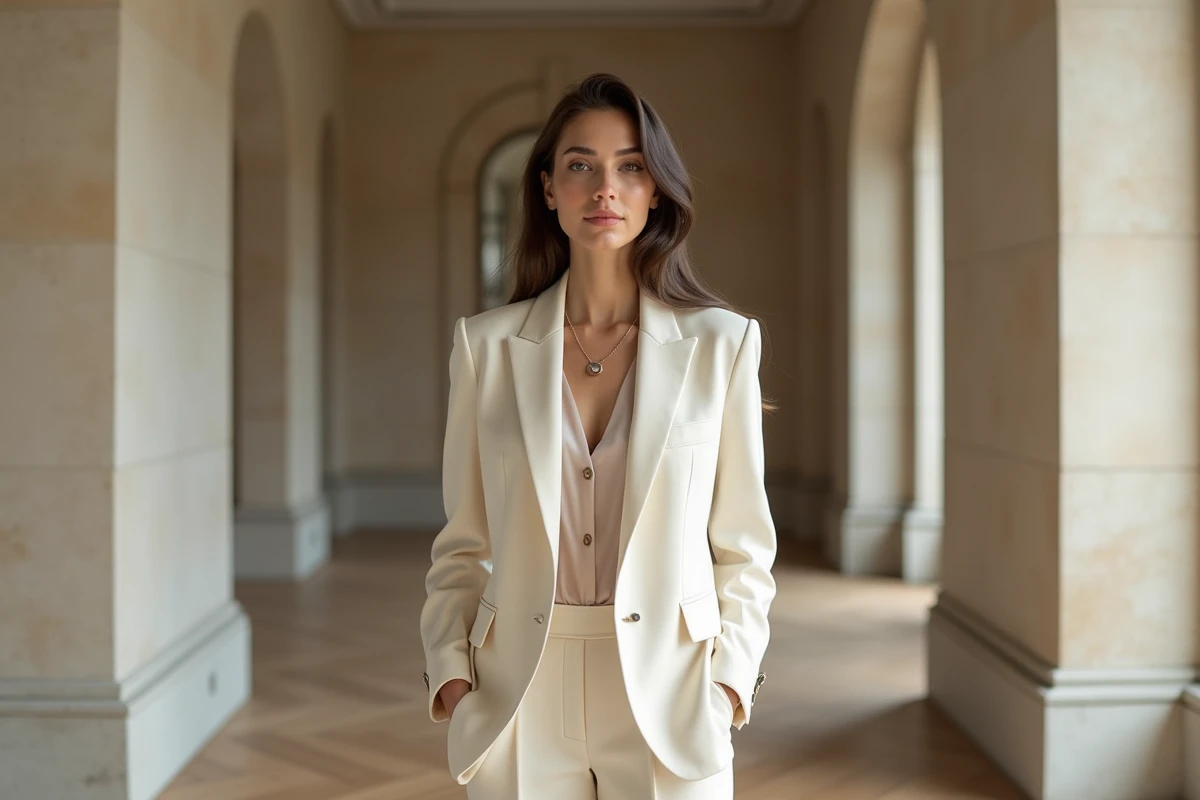
Betul Yilmazturk was named the most beautiful woman in France following an assessment based on facial symmetry and proportions. Originally from Turkey, she was then pursuing business studies at ISEG in Paris, focusing on marketing. Her name has since circulated on dozens of lifestyle and beauty sites, but the editorial treatment she receives deserves attention: the person often disappears behind the symbol.
Betul Yilmazturk, from marketing student to editorial figure
Before this election, Betul Yilmazturk was not involved in the world of beauty pageants. Her initial path was geared towards commerce and digital marketing, a typical curriculum at ISEG in Paris. This detail is rarely elaborated upon in the articles that mention her, even though it sheds light on the rest of her media journey.
Her designation is based on criteria presented as scientific: facial symmetry, facial proportions, harmony of features. The exact protocol of this evaluation remains vague in the available sources. No identifiable academic publication is precisely cited by the sites relaying the information.
This vagueness has not prevented the massive dissemination of the title. The narrative has gradually shifted from a one-time election to the construction of a Betul Yilmazturk elected the most beautiful woman in France, which has become a recurring reference in content related to natural beauty and lifestyle.
Natural beauty and the construction of a media narrative
The sites discussing Betul Yilmazturk almost all employ the same framing: natural beauty without surgery or retouching. This editorial positioning is not trivial. It fits into a broader trend where “French beauty” serves as a full-fledged marketing argument.
Betul’s journey serves as a narrative support. Phrases like “inspiring journey,” “radiant personality,” or “subtle elegance” are regularly found, without these qualifiers being backed by concrete facts. The portrait remains generic, interchangeable with that of any fashion figure.
What the narrative highlights and what it omits
Competing articles emphasize three axes:
- Betul’s Turkish origin, presented as an asset of cultural diversity and “Eastern beauty”
- The claimed absence of cosmetic surgery, which anchors the discourse in naturalness
- The dimension of “role model” for women, without specifying in what way or on what basis
On the other hand, the professional aspect (marketing training, personal communication strategy) is systematically relegated to the background. The title of “most beautiful woman in France” functions as a label, not as the starting point for an analysis of her journey.
Personal image and brand construction: the absent angle
Betul Yilmazturk illustrates a phenomenon that beauty content does not question: the transformation of a personal image into a media brand. Her training in marketing is likely not unrelated to how her image has been disseminated and picked up online.
A beauty title, even based on criteria presented as objective, does not alone generate a lasting presence on the web. It requires constant editorial support, calibrated visuals, and a coherent positioning. The available data does not allow us to conclude whether this strategy is driven by Betul herself or by third parties, but the result is visible: her name is associated with a specific lexical field (natural beauty, French elegance, authenticity).
The model of the proxy influencer
Betul Yilmazturk does not seem to fit the profile of an influencer in the classic sense. The available sources do not mention any brand partnerships, YouTube channel, or massive presence on social media being actively managed.
Her influence comes through another channel: third-party sites that use her name and title as editorial content. Each article that mentions her reinforces the SEO of her name, creates backlinks to beauty and lifestyle sites, and feeds an ecosystem of content that cites each other. It is an interesting case of notoriety built through editorial accumulation rather than direct activity on platforms.

Beauty criteria and the limits of a media election
The election of Betul Yilmazturk raises questions about the very nature of the criteria used. Facial symmetry is regularly invoked in articles, presented as a scientific indicator of beauty. Field feedback diverges on this point: research in psychology shows that the perception of beauty varies across cultures and eras.
Reducing the attractiveness of a face to geometric measurements poses a methodological problem that mainstream content never mentions. Betul’s election is treated as an established fact, not as a debatable result from a protocol whose details are unknown.
- The exact criteria of the evaluation (number of measurements, reference framework used, sample size) are not documented in the accessible sources
- The term “scientific study” is used without reference to a journal, laboratory, or identifiable researcher
- The distinction between classic beauty contests and biometric evaluation remains ambiguous in most articles
The absence of verifiable academic sources weakens the factual foundation on which the entire media narrative surrounding this title rests.
The case of Betul Yilmazturk is less about a woman being named the most beautiful in France than about an editorial mechanism that transforms a vague title into endlessly recyclable content. Her marketing training, her journey as a student in Paris, and the gradual construction of her online image tell a story more complex than that of a symmetrical face. This story remains largely to be documented.