
A drywall partition rests on a metal frame (tracks and studs) covered with plasterboard. The principle seems simple, but the quality of the result depends on technical details that are often overlooked: the treatment of joints, the choice of the complete system, and the accuracy of the initial marking. Mastering these points transforms a rough construction site into a straight, stable, and durable partition.
Specific points in drywall installation: where errors concentrate
Classic tutorials detail the installation of tracks on the floor and ceiling, followed by the screwing of the boards. They rarely spend time on specific points, meaning the junction areas between the partition and the rest of the structure.
The connection between the partition and the ceiling is the most critical. If the partition is rigidly attached to the ceiling without any gap, the movements of the structure (expansion, slab creep) are transmitted to the boards and cause cracks at the corners. Recent guides, particularly those from CSTB and Placo (2024 edition), recommend leaving a gap at the top of the partition and treating it with a resilient strip or a flexible joint.
The junction with an existing wall poses a similar problem. A track fixed directly against a concrete block or brick wall without a decoupling strip transmits vibrations. This reduces the acoustic performance of the partition, even if the rest of the assembly is correct. Applying a resilient strip under each peripheral track (floor, ceiling, side walls) is a quick gesture that changes the final quality.
To delve into each step of the construction site, a work guide on Les Embellies Déco details the progression from marking to finishing touches.
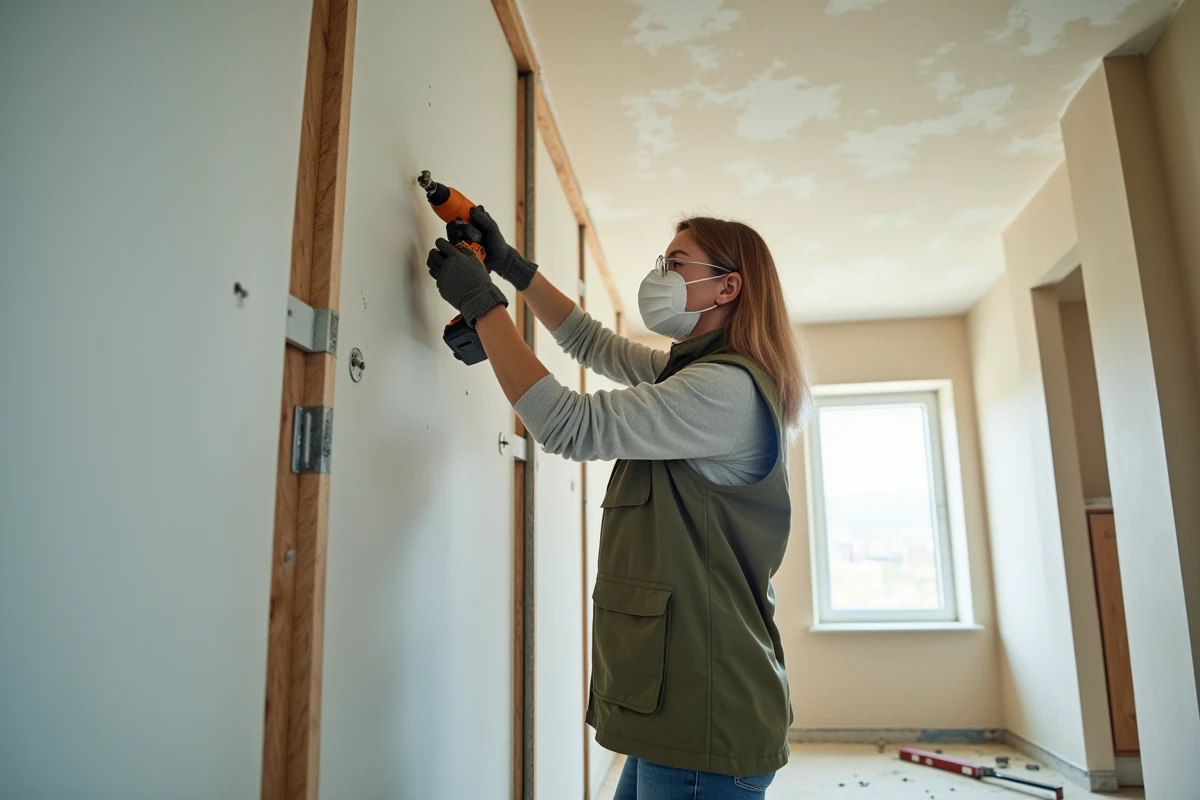
Metal frame: spacing of studs and reinforcement for heavy loads
The frame consists of tracks (fixed to the floor and ceiling) and vertical studs fitted into these tracks. The standard spacing between studs is 60 cm, which corresponds to half the width of a BA13 plasterboard. Adhering to this spacing ensures that each edge of the board falls on a stud, a necessary condition for proper screwing and jointing.
Since the update of DTU 25.41 (2023), recommendations have been strengthened for hanging heavy loads. Fixing a wall-mounted cabinet or TV bracket to a simple BA13 board with expansion plugs is no longer sufficient according to manufacturers.
- Reinforcements integrated into the frame (wooden crossbeam, metal plate, or OSB panel screwed between two studs) must be positioned before closing the partition, at the height planned for the fixing.
- High-density boards (such as Habito from Placo) can accept higher loads in direct fixing, without reinforcement, due to their reinforced fiber composition.
- For a standard BA13 partition, anticipating the location of each heavy attachment point from the marking stage avoids having to reopen the partition later.
This anticipation is the point that separates an amateur construction site from a professional result. A closed partition without reinforcements limits future layout possibilities.
Acoustic insulation of a drywall partition: choosing a complete system
Sliding a roll of glass wool between the studs improves thermal insulation but does not guarantee good acoustic attenuation. The sound performance of a partition depends on the combination of boards + studs + insulation, not on each component taken separately.
Manufacturers (Placo, Siniat, Knauf) have been offering certified complete systems with a measured sound attenuation index in laboratories for several years. A Placostil 72/48 system from Siniat, for example, combines precisely sized studs, a specific type of insulation, and specific boards to achieve tested acoustic performance.
Combining products from different brands or randomly choosing insulation does not guarantee the same result. If sound insulation between two rooms is a goal, it is better to select a referenced complete system rather than assembling separate components.
Insulation thickness and stud width
The insulation must occupy the entire width of the stud without being compressed. A 48 mm stud receives a 45 mm insulation. A 70 mm stud allows for thicker insulation and better sound attenuation, at the cost of a few centimeters of floor space. This compromise between partition thickness and acoustic performance should be decided before purchasing materials.
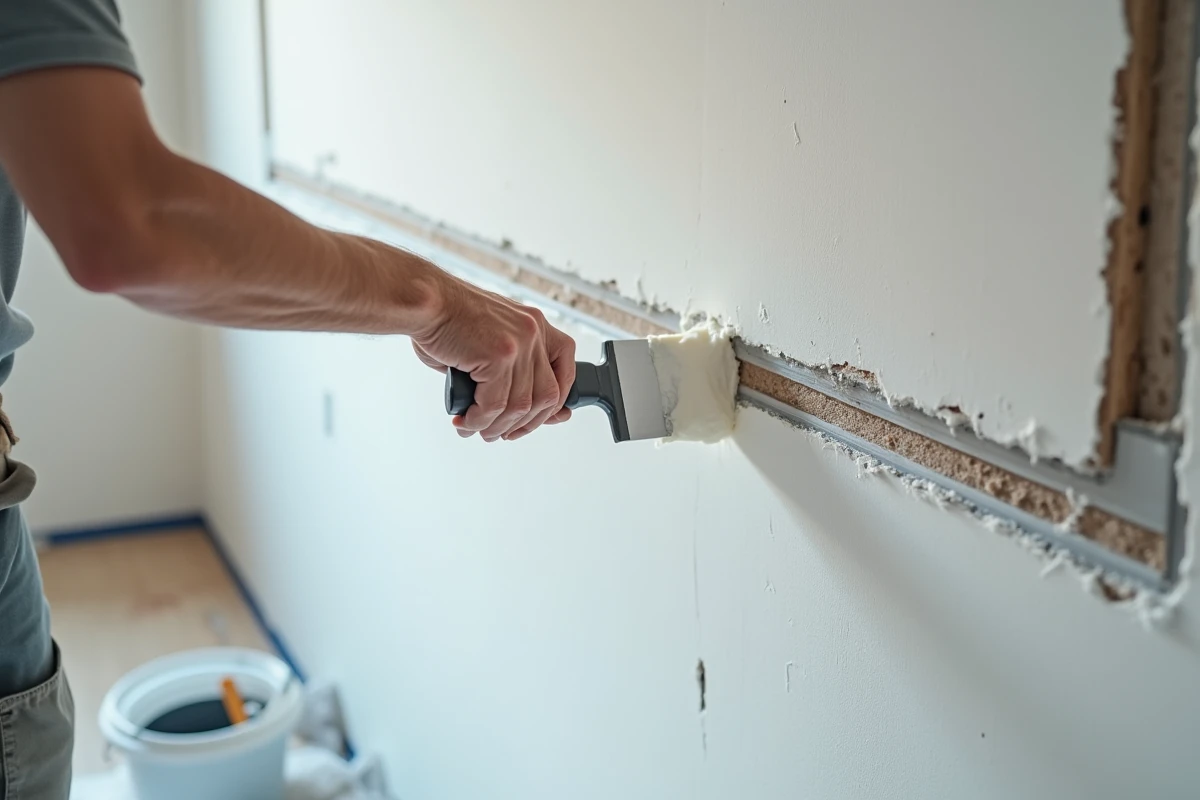
Installation of plasterboards and joint treatment
The boards are screwed onto the studs with self-drilling screws, spaced about 30 cm apart on each stud. The screw head should be flush with the surface without piercing the board’s paper. A depth-stop screwdriver bit makes this operation consistent.
The joints between boards are the visible weak point of a drywall partition. There are two types of board edges:
- Feathered edges (BA) create a slight recess at the joint, designed to receive tape and compound without excess thickness.
- Straight cuts at the board ends (cut edges) do not have this feathering. They require more careful treatment with compound applied in thin, wide layers to avoid bumps.
- Staggering the joints from one row to another (staggered installation) reduces the risk of continuous cracking along the entire height of the partition.
The joint compound is applied in three passes: a bonding layer under the tape, a smoothing layer, and then light sanding. Skipping steps by applying a single thick layer results in a visible joint after painting. Each layer must dry completely before applying the next one.
Cutouts around outlets and switches
The passages for electrical conduits are prepared before installing the second face of the partition. The flush-mounted boxes are positioned in the boards using a hole saw. Marking the exact location of the box before screwing the board avoids rough cutouts that weaken the paper around the outlet.
The initial marking, the choice of a coherent frame/insulation/board system, and the care taken with peripheral joints determine the durability of a drywall partition over time. A well-constructed partition remains invisible: no cracks at the corners, no visible joints, no vibrations when touched.