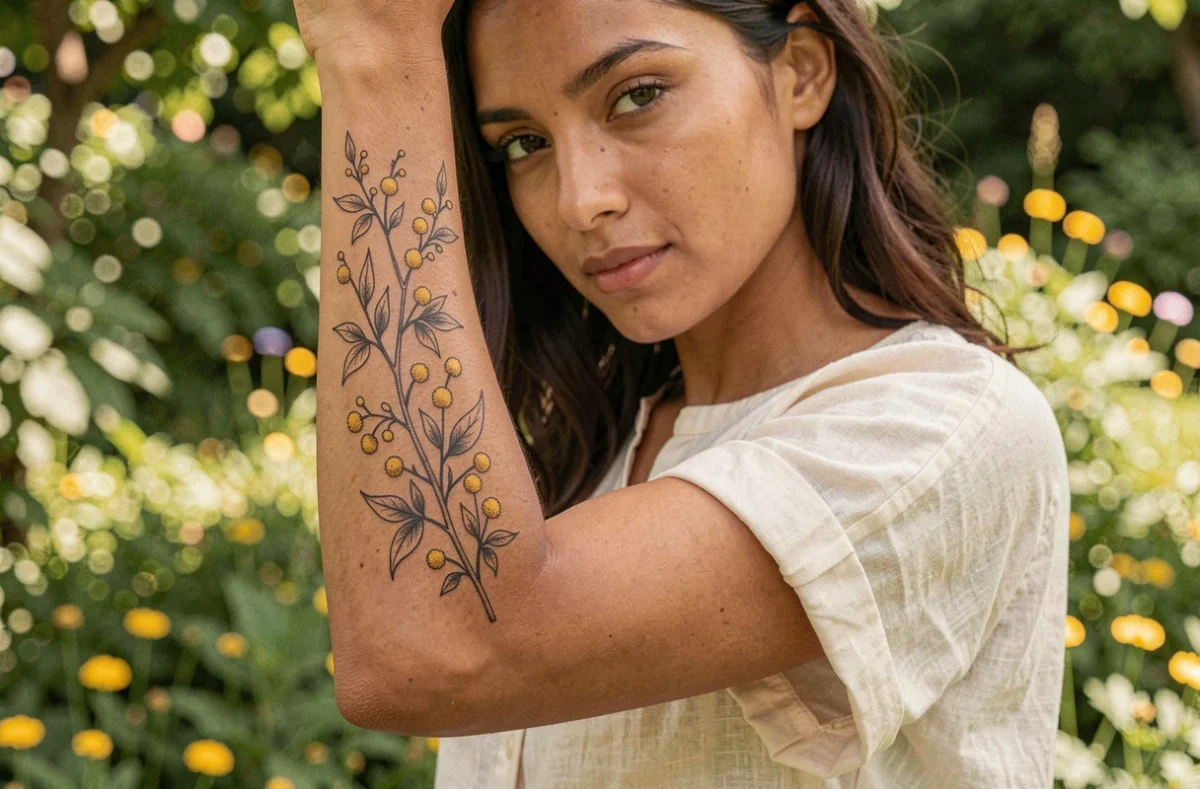
When you choose a mimosa tattoo, you’re not picking from a catalogue of generic symbols. Whether you know it or not, you’re referring to a specific plant, a story rooted in a particular place, and an act of solidarity that emerged in post-war Italy. A mimosa tattoo on your forearm or collarbone carries meaning that goes far beyond decoration.
The tradition of giving mimosa flowers for International Women’s Day dates back to 1946 in Italy. The flower was chosen for practical reasons: it was available in March, grew locally and was inexpensive. Mimosa is a symbol of solidarity rooted in a specific history, not a universal emblem that appeared out of nowhere.
Acacia dealbata or Mimosa pudica: which plant will you have tattooed?
The word “mimosa” refers to several distinct plants, and this botanical confusion changes the meaning of the tattoo. The winter mimosa most tattoo artists depict, with its clusters of yellow pom-pom flowers, is Acacia dealbata, a tree native to southeastern Australia. It is not originally a Mediterranean shrub, even though it has become naturalised in southern France and is considered invasive in some natural habitats there.
Other species are also commonly called mimosa. Mimosa pudica, the sensitive plant, folds its leaves when touched. Albizia julibrissin, the silk tree, produces pink, feathery flowers. Each has a different symbolism: quiet resilience for the sensitive plant, gentleness for the albizia.
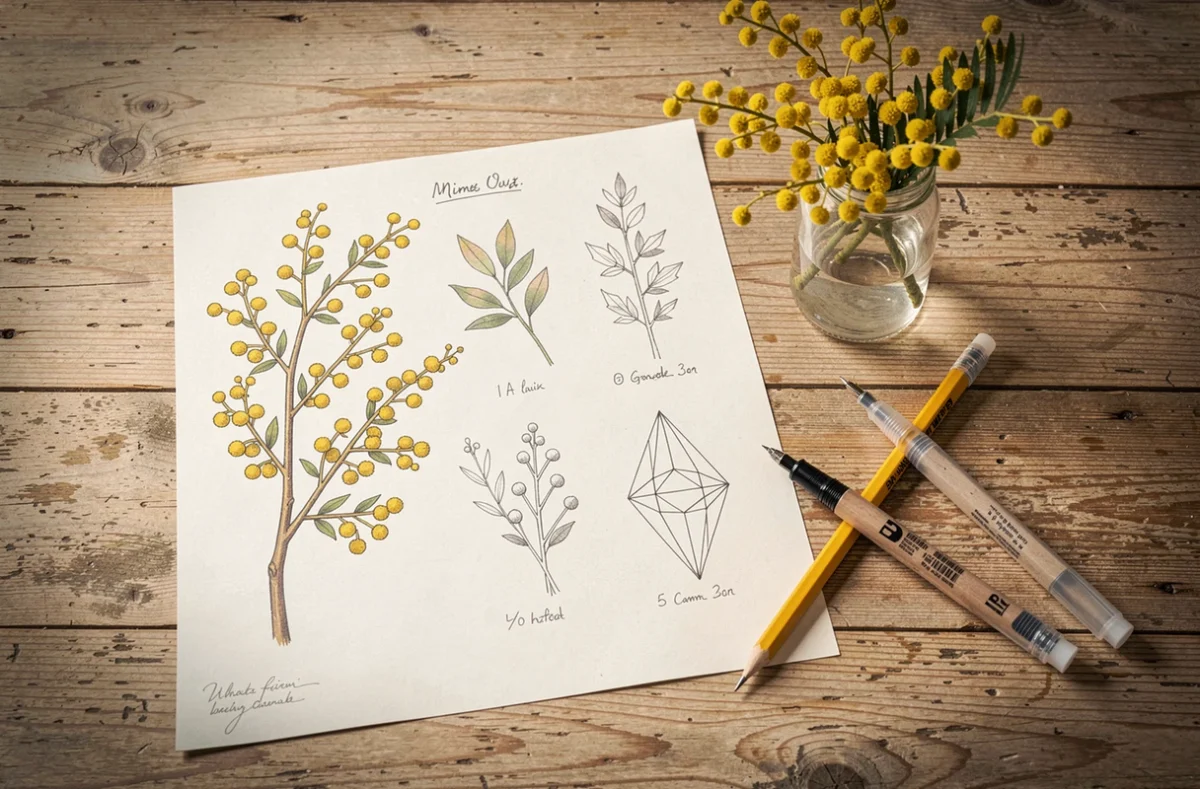
Identifying the species before your tattoo appointment gives the design a precise botanical reference. You can ask your tattoo artist to reproduce the distinctive bipinnate leaves of Acacia dealbata, or the folded leaflets of Mimosa pudica. The design becomes more coherent, and the symbolic meaning of the mimosa you wear is then based on a conscious choice, not a botanical misunderstanding.
Mimosa tattoos and March 8: a statement of solidarity, not a floral celebration
Many people associate mimosa with March 8 without knowing its origins. International Women’s Day is rooted in labour movements and the fight for civil rights. The March 8 mimosa tradition is specifically Italian, not a commercial celebration.
In 1946, Italian activists were looking for an accessible, recognisable flower to mark the day. Mimosa met these practical requirements. The gesture has since spread beyond Italy, but its original meaning remains rooted in an act of collective solidarity.
For a tattoo, this history changes the intention behind the design. You’re not getting “a pretty yellow flower” tattooed. You’re marking a commitment on your skin. Some people choose to add a date (March 8) or a word in Italian to highlight this connection. Others prefer to leave the design on its own, relying on the recognisable golden pom-poms.
Pairing mimosa with other graphic elements
A sprig of mimosa works well as part of a composition. It can be paired with elements that reinforce its activist or personal meaning:
- A stylised raised fist, to make the symbol’s protest message unmistakable
- A handwritten date (a birth, a significant event), linking the mimosa to a personal moment of solidarity or resilience
- Other flowers with strong symbolic meaning (lavender, poppy), creating a bouquet in which each species has its own story
Mimosa tattoo styles: what works for different placements
Mimosa presents a specific technical challenge: its spherical pom-pom flowers become hard to make out if they’re too small. On a finger or behind the ear, the flower heads can blur into a yellow patch after a few years. For a design that lasts, it’s best to keep miniature tattoos to fine black linework, without solid colour.
On a forearm or calf, there’s room to work with shading. Watercolour style captures the gradients from bright yellow to gold, while a botanical style (fine lines, hatching and detailed stamens) suits anyone who wants to highlight the precision of the chosen species.

Black and grey or colour
Black-and-grey mimosa tattoos work well when they use contrasts in density between the delicate leaves and compact flower clusters. Yellow ink fades faster than darker pigments, especially on fair skin exposed to the sun. If you want to preserve the original vibrancy, expect to get touch-ups after a few years.
- Small design (wrist, ankle): choose fine linework without fill to prevent details from disappearing over time
- Medium design (forearm, shoulder blade): watercolour or realistic botanical style, with or without colour depending on how you feel about touch-ups
- Large design (thigh, back): mixed compositions featuring foliage, stems and other elements, with enough space between the flower clusters to keep them distinct
Invasive mimosa: when a tattoo also carries an ecological dimension
In France, horticultural sources describe Acacia dealbata as invasive in some natural habitats in the south. Its shoots quickly colonise disturbed land, and its root system competes with local vegetation. However, it is not formally regulated as an invasive alien species under the law.
This ambiguity can add depth to a tattoo’s meaning. A plant that is both luminous and invasive creates an intriguing tension: beauty, tenacity and the ability to take root where it wasn’t expected. For some people, it’s precisely this duality that resonates with their personal journey.
A mimosa tattoo doesn’t have to be limited to a single symbolic meaning. Between its history as a symbol of Italian activism, the botanical specificity of the species and the ecological reality of a plant that refuses to be contained, this design offers unusual depth for a flower often seen as simply “cheerful”. Choosing the species, style and placement is enough to express an intention that doesn’t always need words.