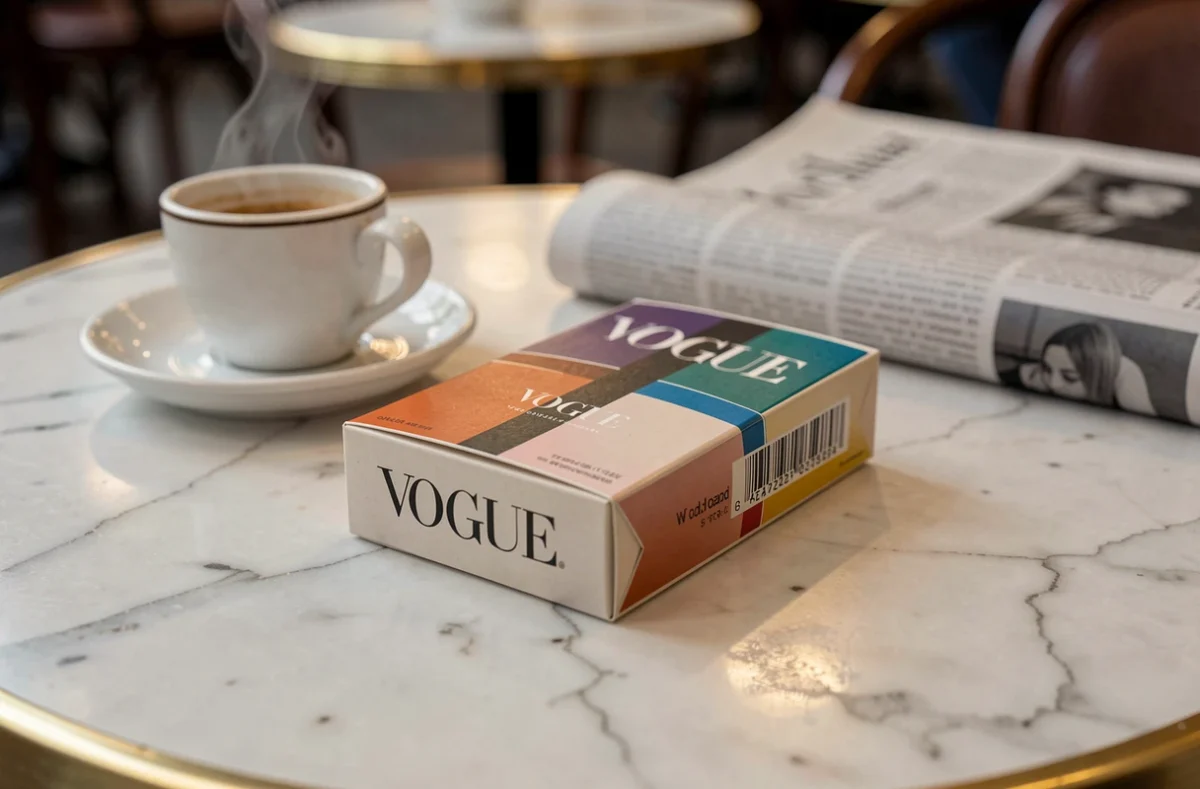
Vogue cigarettes come in several varieties, identified by names that evoke specific colours or visual themes. For smokers, these names naturally suggest a particular flavour profile, throat hit or degree of smoothness.
However, France’s plain packaging requirement has removed the visual cues that once distinguished each variant. The gap between what a name suggests and what the cigarette actually tastes like is worth examining, without claiming to assess the harmfulness or safety of these products.
Sensory expectations and colour: what research shows about vaping, not Vogue
A study of e-cigarettes found that a product’s colour influences the taste users expect before their first puff. Participants associated certain shades with greater sweetness and others with a stronger hit, even though the contents were exactly the same.
This finding concerns expectations, not an objectively measured difference in taste. Applied to Vogue, it suggests that a smoker buying a variant whose name evokes white or pastel colours may expect a lighter sensation. That expectation shapes perception from the first inhalation, regardless of the actual blend.
The same study found that health warnings reduced appeal and expected taste, particularly for colourful models. In other words, sensory impressions do not depend on a single visual cue: the name, colour, health message and product format all interact. It is therefore difficult to quantify the effect of any one factor on the hit or aftertaste of a Vogue White Original Pastel cigarette outside a controlled study.
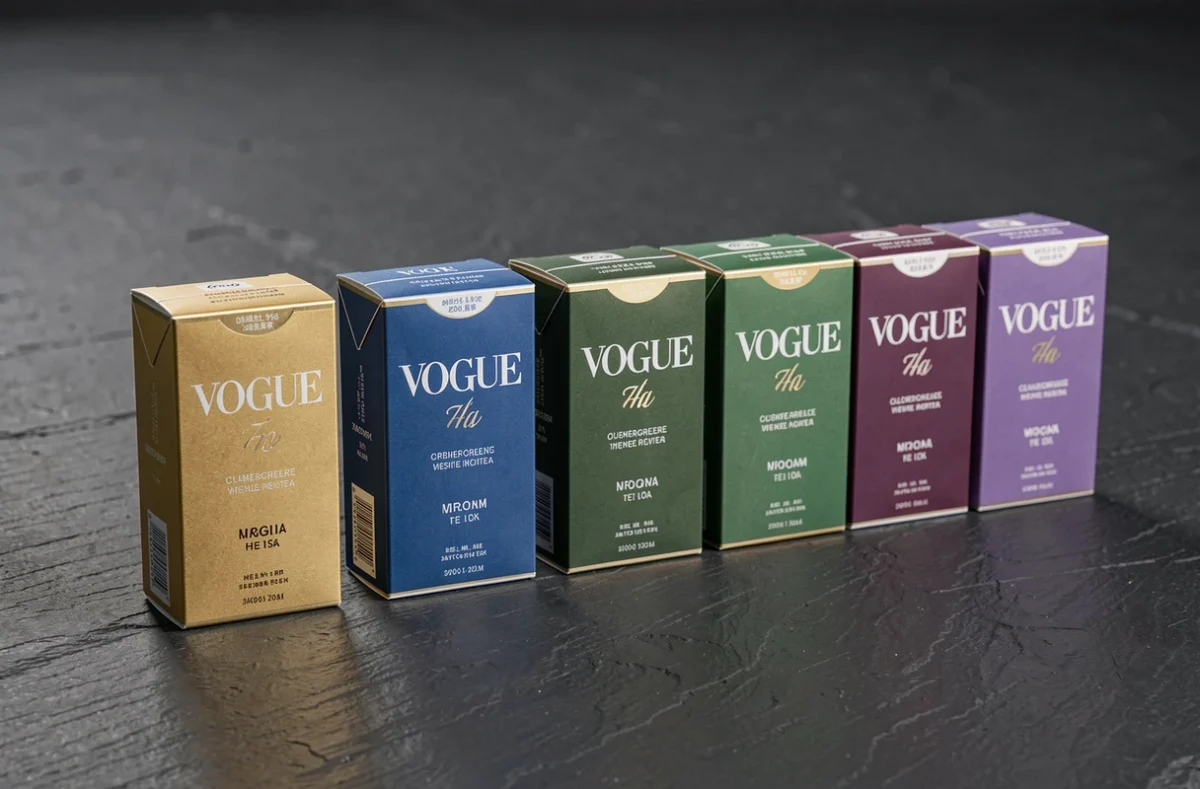
Plain packaging in France: the brand name replaces colour as a taste cue
Since standardised plain packaging came into force, decorative colours and distinctive visual elements have been banned from cigarette packs sold in France. All brands, including Vogue, now come in identical khaki-brown packaging.
The variant name has become the only reliable way to tell one Vogue from another at a tobacconist. Names such as “Menthe”, “Lilas” and “Bleue” still evoke a colour scheme, but that code no longer corresponds to any visual cue on the pack itself.
Direct impact on smokers’ perceptions
When a smoker used to Vogue Lilas switches to another variant without a familiar visual cue, they lose the sensory prompt triggered by the old coloured pack. Several smokers have reported online that the same variant seems “different” to them since the introduction of plain packaging, even though the declared tobacco composition has not changed.
This phenomenon shows just how much colour acted as a perceptual filter before the smoke even reached the throat. Removing that filter does not change the blend, but it does alter how the brain interprets the hit and aftertaste.
Slim Vogue cigarettes and perceived smoothness: don’t confuse format with colour
Vogue cigarettes are slim. Smokers have long associated this slender format with a lighter, smoother sensation than standard cigarettes. A proposal to ban slim cigarettes was also discussed while the European tobacco directive was being drafted, but was dropped from the final version.
Slim cigarettes are often perceived as less harmful, a mistaken belief that the format actively reinforces. Their smaller diameter changes the draw: resistance is greater, which can create the impression of a smoother throat hit.
A common misconception is to attribute this smoothness to the colour associated with the variant, when it largely comes from the format shared by all Vogue cigarettes. Here are the factors that actually influence how they feel in the mouth:
- The slim format increases draw resistance, slowing the flow of smoke and softening the perceived throat hit
- The tobacco blend (leaf type, cut and any additives) determines the aftertaste, which varies from one variant to another regardless of the colour associated with its name
- The declared tar and nicotine levels on the pack are the only quantified indicators, although they do not exactly reflect how much a smoker actually inhales
- The visual environment (the old coloured pack or today’s plain pack) shapes expectations before the first puff
What smokers report after use versus what the name promises
Online discussions among Vogue smokers reveal a recurring mismatch. Variants whose names suggest lightness (pastel, white, lilac) are bought with the expectation of a minimal hit and subtle aftertaste. In practice, reports are more nuanced.
Some smokers describe a throat hit that is similar between a supposedly “smooth” variant and a “classic” one, noting a difference mainly in how long the aftertaste lasts rather than in the intensity of the initial impact. Others describe Vogue Bleue as drier, though this observation has not been confirmed by independent measurement.
No controlled sensory comparison of the different Vogue variants has been published in the available scientific literature. Smokers’ accounts remain subjective and are influenced by the expectations generated by a variant’s name, as the mechanism described above would predict.
Why aftertaste divides opinion more than the hit
The hit depends mainly on nicotine levels and combustion temperature, two parameters that are relatively stable across Vogue variants in the same format. Aftertaste, by contrast, is linked to each variant’s specific blend and the aromatic compounds released during combustion.
This is where differences between colours (or, more accurately, names) are most likely to be real. A blend dominated by Virginia tobacco does not leave the same taste as one that includes Burley. The colour does not change the tobacco, but the tobacco varies by variant, and it is the tobacco that produces the aftertaste.
Colour’s influence on the experience of a Vogue cigarette therefore has more to do with expectations than with any physical property of the product. The name guides the choice, the format shapes the draw, and the blend determines what remains in the mouth after the last puff. Separating these three factors makes it easier to choose a variant for what it contains rather than what its name suggests.