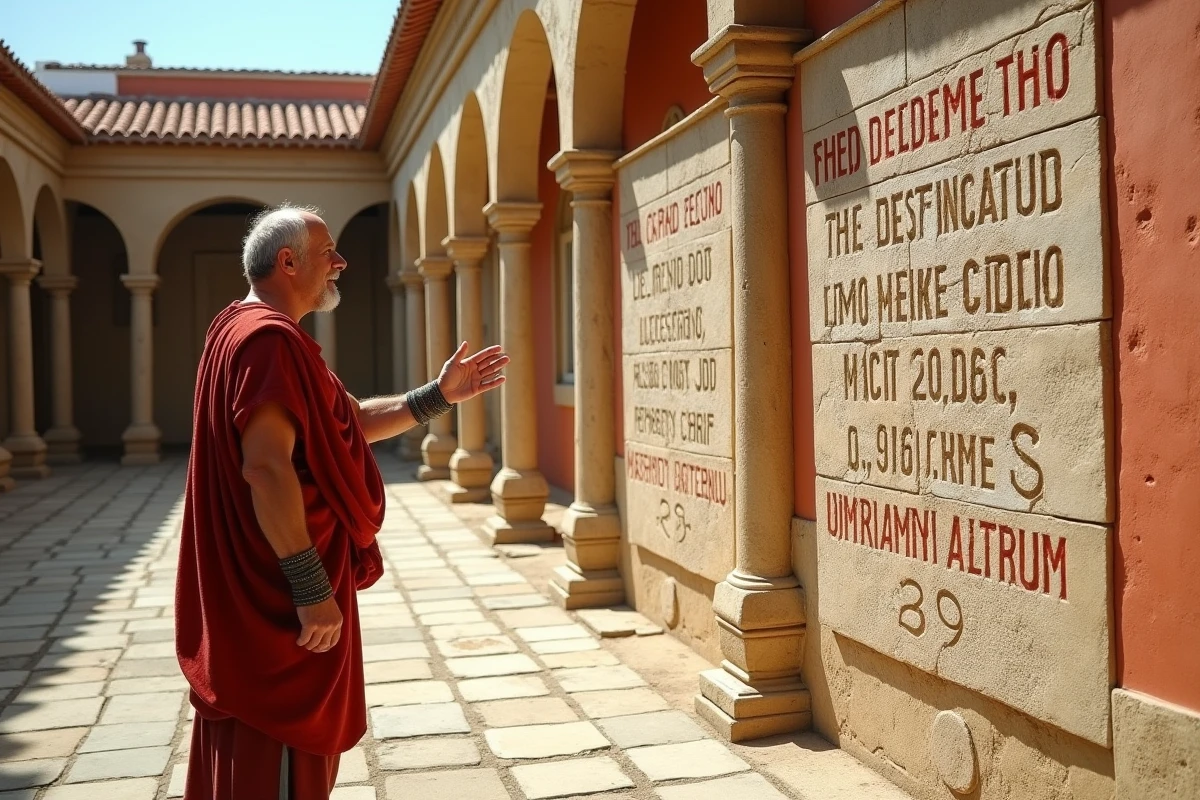
Before agencies, television spots, and algorithms, advertising already existed in forms that we would have difficulty recognizing today. From the painted walls of Pompeii to the banners of Roman peddlers, promotional techniques have accompanied commerce since its earliest organized structures. Tracing this history means understanding how the need to capture the attention of a potential buyer shaped visual, auditory, and regulatory practices long before the printing press.
Mobile Billboards and Town Cryers: Late Antiquity Advertising
Competitors tracing advertising history often start with wall frescoes and inscriptions on pottery. A less documented angle concerns the animated advertising media of Late Antiquity. According to a report published in the journal Antiquité Tardive (n°31, 2023, Brepols), peddlers and town criers moved through late Roman cities with painted signs or banners, combining text, image, and oral performance.
These mobile promoters advertised everything from shows to baths or taverns. The process already combined three registers: the visual (colors, pictograms), the textual (short slogans), and the auditory (projected voice, sometimes accompanied by music). Here we find a direct ancestor of point-of-sale advertising and mobile displays, two practices that are often thought to be recent.
Understanding the origin of advertising thus requires going beyond a simple inventory of static frescoes to incorporate this performative dimension, where the messenger was part of the message.

Logos and Rhymed Slogans in Song and Ming Dynasty China
The history of advertising is not limited to the Mediterranean basin. An article by Qimei Chen published in the Journal of Historical Research in Marketing (vol. 15, n°1, 2023) describes how, under the Song and Ming dynasties, Chinese merchants used stylized logos, rhymed slogans, and sound brands to stand out in large urban centers.
The “sound brands” consisted of tunes sung in the streets, associated with a specific seller or type of merchandise. Passersby identified the product even before seeing the stall. This strategy of differentiation through sound and rhythm anticipates what contemporary marketing calls sound branding.
Engraved logos on signs served to build customer loyalty in very dense markets, where competition among artisans and merchants was fierce. The advertising rhyme facilitated memorization, just like a radio jingle several centuries later. The principle of memorable repetition runs throughout advertising history, regardless of the civilization in question.
Regulation of Signs in Hanseatic Cities in the 15th Century
Pre-modern advertising did not evolve in a legal vacuum. An article from 2022 published in Urban History shows that several Hanseatic cities already imposed restrictions on commercial signs in the 15th century. The rules targeted devices deemed too prominent or too noisy, for reasons of public safety and urban tranquility.
These regulations represent a little-known fact in classical narratives about advertising history. They prove that the tension between commercial promotion and public order dates back to the Middle Ages. Municipal authorities were already arbitrating between merchants’ rights to signal their activities and the comfort of residents.
The types of restrictions documented in these cities included:
- Limiting the size of protruding signs on public thoroughfares to prevent falls and obstructions
- Regulating public criers, whose hours and routes were sometimes set by municipal ordinance
- Prohibiting certain sound devices deemed excessive near places of worship or official buildings
This medieval regulatory framework foreshadows the codes of outdoor advertising that we know today. The logic has not changed: to regulate commercial visibility to preserve common space.

Medieval Fairs and Printed Posters: Advertising Scales Up
The fairs of the Middle Ages and the early modern period constituted a large-scale advertising experimentation ground. Merchants used banners, visually elaborate displays, and product demonstrations to attract visitors. The concentration of sellers in one location made differentiation through visuals and discourse essential.
The advent of the printing press marked a technical turning point. The first printed advertising posters allowed the same message to be reproduced in series and disseminated across multiple neighborhoods or cities simultaneously. The printing press transformed advertising from a local act into a reproducible tool.
From Town Crier to Poster: What Changes and What Remains
The transition from town crier to printed poster does not eliminate the oral dimension. The two coexisted for several centuries. However, the poster introduces a fundamental novelty: the advertising message persists in the absence of its sender. The merchant no longer needs to be physically present to promote their goods.
This persistence of the message paves the way for modern advertising practices, where the medium (newspaper, poster, screen) gradually replaces the human voice as the primary vector of promotion. The posters of the 19th century, often considered the first “modern” advertisements, fit into this direct continuity.
The history of advertising before the modern era outlines a continuous thread between practices that are often too readily opposed. Roman peddlers, Chinese merchants, Hanseatic artisans, and printers all sought to solve the same problem: making a product visible in an environment saturated with solicitations. The media have changed, but the constraint remains the same.